VI. A Sketch is a Question
On keeping the issues open when the artefact behaves.
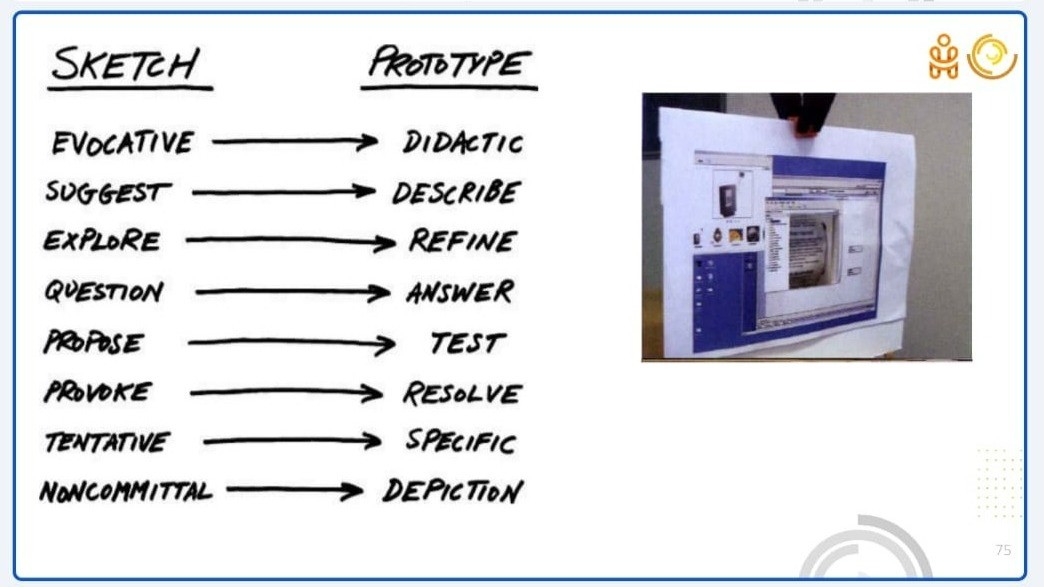
Note: This essay continues a series. The The Brief Always Arrives Wrong argued that design’s most consequential work is the constituting of problems. The Web of Issues drew on Horst Rittel to argue that the design process is irreducibly argumentative. The Quarrel That AI Reopened and Two Stopping Rules set Rittel against Herbert Simon over the framing of problems and the ending of work. The Resolution of the Argument, to which this essay is a direct sequel, showed that the web of issues is not medium-neutral: that design arguments depend on representations loose enough to argue in, and that generative tools squeeze that middle band from both ends. This essay takes the claim to the design of interactive digital products, whose subject matter is behaviour, and whose behaviour has never had a sketch. I thank my colleague for sharing a slide from his lecture (used here as the cover image for the article) and reminding me about Bill Buxton, which motivated this article.
The previous essay’s hero was the sketch, and the sketch has a limitation that essay did not dwell on. It is a graphic instrument. Its ambiguity lives in marks: in lines loose enough to be read at several levels of abstraction at once, by several people holding different positions. This serves the designer of static things well. A poster, a chair, a building elevation can all be held open on paper, because what is being designed is a form, and a form can be depicted at any degree of unsettledness the argument requires.
An interactive product is not a form. It is a behaviour: what the thing does when touched, how it responds, defers, interrupts, remembers; whether it feels obedient or wilful, brisk or patient. And behaviour unfolds in time, which paper does not. A screen can be sketched. A feel cannot. The designer of interaction faces the previous essay’s problem in its hardest version: her web of issues is fullest exactly where the sketch cannot reach, in the temporal, responsive, felt dimension of the artefact, and the medium that keeps issues open for every other design discipline goes silent at the boundary of her subject matter.
This is the problem Bill Buxton placed at the centre of Sketching User Experiences, still the most careful account interaction design possesses of its own representations [1]. The disciplines that design static things inherited their middle band from centuries of drawing. Interaction design was born without one. So the field built one; and read with the previous essay in hand, the history of prototyping methods in human-computer interaction stops looking like a catalogue of techniques and starts looking like something grander: a fifty-year engineering project to construct, artificially, the representational register that design thinking requires and that the medium refused to provide.
A Sketch Asks, a Prototype Answers
Buxton’s central distinction is usually remembered as a fidelity scale, low against high, rough against finished. It was never one. A sketch and a prototype, he insisted, can be materially identical; what separates them is what they are for. Sketches suggest, explore, provoke, question. Prototypes describe, refine, test, answer. The attributes he catalogued for the sketch, that it be quick, plentiful, cheap, disposable, deliberately ambiguous, and refined no further than the thinking behind it has actually settled, are not aesthetic preferences. Read against this series, they resolve into a single principle: the sketch is the question-form of a design representation. It puts an issue into the room without closing it. The previous essay showed why such a form is load-bearing; Buxton’s book is the field manual for building one when the subject matter resists.
Because the subject matter does resist, and the hard part is time. To sketch an interactive product you must sketch its behaviour, and behaviour is invisible in any single frame. Hence the invented repertoire, each entry a different solution to the same impossible brief. The storyboard, borrowed from film, holds a behaviour as a sequence of moments loose enough to argue over. The paper prototype makes the behaviour manual: a person plays the computer, swapping hand-drawn screens in response to a user’s touches, so that the interaction is experienceable while remaining, literally, up in the air. The video sketch performs an interaction that does not exist. Experience prototyping, in Buchenau and Fulton Suri’s account, goes further and has the design team undergo an approximation of the experience itself, on the principle that some issues can only be opened from inside a body [2].
And then there is the purest instrument of them all, the Wizard of Oz method, named for the man behind the curtain: a human improvises the machine’s responses while a user interacts with what she believes is a working system [2]. It is worth pausing on what this actually achieves, in the vocabulary of this series. The behaviour is experienceable, arguable, testable against a person’s unrehearsed reactions, and it is not yet fixed. The wizard can change her mind between sessions, or within one. The issue of how the system should behave is held open in precisely Rittel’s sense, while being explored with all the vividness of a working thing. That is behavioural ambiguity, manufactured; the sketch the medium refused, built out of a person and a curtain.
The Laboratory Agrees
What makes interaction design the strongest witness for the previous essay’s argument is that the field did not take the argument on trust. It tested it, over decades, and the findings converge from three directions.
The first is that feedback follows fidelity. From Rettig’s early case for paper prototyping through the low-versus-high fidelity debate of the nineties, the same observation recurs: show a polished artefact and you receive comment on its polish, on colours, wording, and corner details; show a rough one and you receive argument about structure, about whether the flow is right and whether the task is even the task [3]. The representation determines which issues the room is able to open. The previous essay made that claim from cognitive science, through Goel’s drawing experiments. The prototyping literature made it from the field, with users and stakeholders instead of experimental subjects, and reached the same result.
The second is that fidelity is not one dial. McCurdy and colleagues broke it into five independent dimensions: visual refinement, breadth of functionality, depth of functionality, richness of interactivity, richness of data; and showed that a competent prototype is routinely high on one and deliberately low on the others [3]. Houde and Hill had already asked the disarming question in their title, what do prototypes prototype, and answered that a prototype prototypes something, never everything: a role, a look and feel, an implementation, but not all at once. Lim, Stolterman and Tenenberg completed the thought: a prototype is a filter, traversing the design space by isolating the dimensions of interest, and the best prototype is the simplest artefact that filters the dimension in question [3]. Assemble the three and the field’s collective finding is exactly this essay’s title. A prototype, properly conceived, is a question about a chosen dimension, put in a form that holds every other dimension open. The craft is deciding what the artefact is allowed to answer.
The third direction is the strangest and the most telling: the field built software whose explicit purpose was to preserve ambiguity. Landay and Myers’s SILK let designers sketch interfaces electronically and deliberately kept the marks sketchy, because their studies showed that premature neatness changed what design teams argued about; its successor DENIM did the same for the early design of websites [4]. Sit with that for a moment. An entire research lineage, inside the discipline of computing, devoted to preventing computers from making design representations too determinate too early. It is the exact inverse of the design philosophy of the generative tools, and it was built on evidence.
There is a fourth witness, older and warmer, from outside the laboratory. In the Scandinavian workplace projects of the eighties, Pelle Ehn and his colleagues designed newspaper production systems with the typographers who would use them, and their instrument was the cardboard mock-up: a computer made of plywood and paper, rough enough that any hand in the room could move a label or redraw a screen [5]. The roughness was the politics. A representation determinate beyond a participant’s competence to alter it excludes that participant from the argument; the cardboard computer kept the web of issues open to the people who held the knowledge Rittel said no single head contains. Ambiguity, in that tradition, is not only a cognitive resource. It is the condition of participation.
The Inversion
For twenty years, Buxton’s case for sketching was heard mainly as economics. Sketch because sketches are cheap, plentiful, disposable; do not spend on polish what you have not yet earned in understanding. It was sound advice for as long as polish was expensive, and it is the reading the field mostly retained, because economic arguments travel well in organisations.
Generative tools have killed the economic reading. The working, populated, data-rich prototype is now the cheapest artefact in the room. The paper prototype is now the expensive one: expensive in time-to-impressiveness, in credibility with stakeholders reared on renders, in the patience it demands of a team that knows a finished-looking alternative is one prompt away. And the death of the economic case exposes what it was always covering for. The epistemic case stands alone for the first time: sketch not because it is cheap, but because it is a question, and because a practice that never puts its issues in question-form will have them answered by default.
The exposure matters most here, in interaction, because this field’s middle band was artificial from the start. The graphic designer’s sketch survives on its own; it is how hands think. The interaction designer’s repertoire, the storyboards and paper screens and wizards, survives only by discipline, because every entry in it is more effortful than the thing it replaces. Squeeze it, as the previous essay said of the graphic middle band, not by decision but by convenience, and it does not thin. It vanishes.
The method put a human behind the curtain so that behaviour could stay open. The generative tool puts a machine behind the curtain and fixes the behaviour before the designer has decided what to ask.
The sharpest image of what is lost is the Wizard of Oz method run in reverse. The method put a human behind the curtain so that behaviour could stay open while being experienced. The generative tool puts a machine behind the curtain and fixes the behaviour before the designer has decided what to ask. In Lim’s vocabulary, a generated application filters nothing: it arrives high on all five dimensions at once, an answer to every question including the hundreds nobody asked. It is a prototype for no question. And the previous essay’s warning about decorative ambiguity applies with doubled force, because a generated app in wireframe costume is determinate in the one register no wireframe style can disguise: it behaves, and its behaviour is already committed.
Deciding the Question
The response, as throughout this series, is sequence and repertoire rather than abstinence; but interaction design needs one discipline more specific than the previous essay could give it. For every artefact, made or generated, decide in advance which single issue it is permitted to close. Then set the fidelity of each dimension separately, matched to the actual settledness of the thinking about it: interactivity rich where the behaviour is genuinely under test, visuals deliberately grey where the form is not yet in question, data plausible where trust in content is the issue and dummy where it is not. This is only the fidelity literature taken at its word, McCurdy’s five dials set one at a time instead of slammed together to maximum.
Under that discipline, the generative tool becomes usable as the field’s methods were always used: as a wizard whose curtain the team still holds. Generate the behaviour and withhold the surface, when behaviour is the question. Generate the surface and script the behaviour by hand, when it is not. And treat every answer the artefact volunteers to a question the team did not ask as noise to be disregarded, never as a decision to be inherited; because inherited decisions, the previous essays have argued, are exactly how a web of issues closes without anyone having judged anything.
A sketch is a question. A prototype is an answer. A generated artefact is an answer that arrives before the question, and the discipline of interaction design, restated for the present moment, is to put the question back in front. What becomes of the answers, whether the adequacy of any of them can ever be verified at all, is the next essay’s problem.
Notes
[1] Bill Buxton, Sketching User Experiences: Getting the Design Right and the Right Design (Morgan Kaufmann, 2007). The sketch-prototype distinction, the attributes of sketches, and the insistence that the difference is one of purpose rather than fidelity are the book’s spine; its subtitle names the two activities the distinction separates. Buxton’s larger argument, that organisations fail at design not for want of designers but for want of a sanctioned early phase in which sketching is what one is paid to do, is the institutional counterpart of this series’ argument about the studio.
[2] The Wizard of Oz method originates with J. F. Kelley’s work at IBM in the early eighties on natural-language office applications, where the machine’s understanding was improvised by a hidden experimenter; the name followed the mechanism. Experience prototyping is from Marion Buchenau and Jane Fulton Suri of IDEO, in the proceedings of the first Designing Interactive Systems conference of the new century. Both methods, along with the storyboard, the paper prototype, and the video sketch, are treated at length in Buxton’s book, which is the best single map of the repertoire.
[3] Marc Rettig’s advocacy of paper prototyping appeared in Communications of the ACM in 1994 under the title “Prototyping for Tiny Fingers”; the fidelity debate is usually dated to Rudd, Stern and Isensee’s exchange in interactions in 1996. The five dimensions of fidelity are from McCurdy and colleagues at CHI 2006. Stephanie Houde and Charles Hill’s “What Do Prototypes Prototype?” appeared in the Handbook of Human-Computer Interaction in 1997. The account of prototypes as filters, and the economic principle that the best prototype is the simplest artefact filtering the dimension of interest, is from Youn-kyung Lim, Erik Stolterman and Josh Tenenberg in ACM Transactions on Computer-Human Interaction, 2008.
[4] SILK is due to James Landay and Brad Myers in the mid-nineties; DENIM to Lin, Newman, Hong and Landay at CHI 2001. Both systems recognised electronic beautification as a threat to early design conversation and engineered against it. Their intellectual kinship with the failure of formal design-rationale capture, recorded in the previous essay through Shipman and Marshall’s “Formality Considered Harmful,” is direct: the same premature determinacy, arriving through a different door.
[5] Pelle Ehn, Work-Oriented Design of Computer Artifacts (1988), reporting among other things the UTOPIA project’s cardboard and plywood mock-ups, built with and for newspaper typographers. The tradition’s insight, that the accessibility of the representation determines who may participate in the argument, is Rittel’s second ground made tactile: if the knowledge a wicked problem requires is distributed, the representations of the problem must be alterable by the people among whom it is distributed.
Essays In The Series
Index of essays on design practice in the age of generative AI