V. The Resolution of the Argument
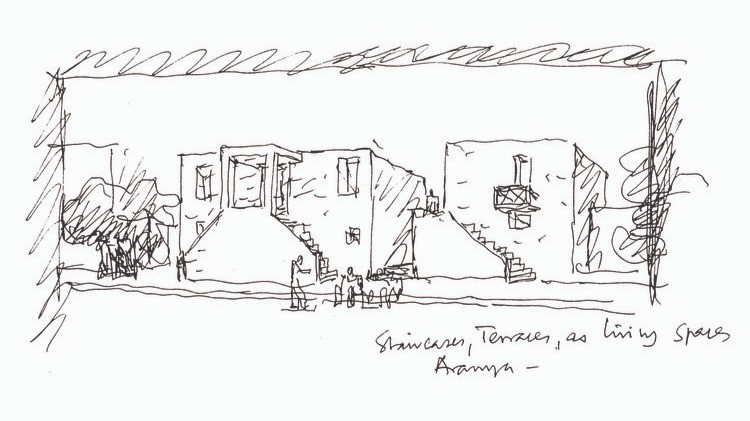
On sketches, prompts, and the level of abstraction at which design arguments live.
Note: This essay continues a series. The Brief Always Arrives Wrong argued that design’s most consequential work is the constituting of problems. The Web of Issues drew on Horst Rittel to argue that the design process is irreducibly argumentative. The Quarrel That AI Reopened set Rittel against Herbert Simon; Two Stopping Rules examined how the work ends. This essay grew out of a conversation with my colleague Kartikeya Date for which I am grateful. It returns to the web of issues and asks a question the earlier essay left unexamined: what are the issues, positions, and arguments made of?
There is an assumption hidden in Rittel’s framework, and it was hidden in this series’ account of it too. Issues, positions, and arguments sound like linguistic entities; things that are said, written, asserted, rebutted. Rittel’s Issue-Based Information System made the assumption literal: a structure of nodes and links, each node a proposition, the whole web a text. And the research tradition that tried to build tools on that structure discovered, slowly and painfully, what the assumption cost. Designers asked to record their deliberations in formal notation did not experience the recording as a service to the deliberation. They experienced it as a falsification of it. The act of forcing a half-formed position into a determinate sentence changed the position; usually by killing the part of it that was still alive. Researchers eventually gave this failure a name, and the name was a warning: formality considered harmful [1].
The failure was not a failure of interface design or of professional discipline. It was a clue about the nature of design thinking, and two scholars in particular followed it to its source. What they found is that the web of issues is not medium-neutral. Positions in a design argument live at particular levels of abstraction, move between those levels, and depend for their creative life on representations that can move with them. Change the representational mode and you do not merely change how the argument is recorded. You change which arguments can occur.
The Sketch Is Not a Record
Gabriela Goldschmidt spent years studying what designers actually do when they sketch, and her central finding dismantles the common-sense picture of sketching as the notation of ideas already had. The designer sketching is not transcribing a mental image. She is conducting a dialogue with the marks, oscillating between two kinds of reading that Goldschmidt called seeing as and seeing that: now reading the marks figurally, as depicting something; now reading off non-figural consequences, implications the marks turn out to carry that nobody put there. Donald Schön had described the same phenomenon as the situation talking back. The sketch answers. And what it says is frequently a surprise: studies of designers reviewing their own sketches show them perceiving relations and possibilities they did not intend and could not have stated in advance [2]. The sketch is not a record of a position. It is the medium in which positions form, and the instrument by which a designer discovers what her position turns out to be.
The property that makes this possible is one the sketch is usually criticised for: its ambiguity. A sketch is readable at multiple levels of abstraction simultaneously, and this mobility is not noise but function. Watch a product team at a whiteboard. The same box-and-arrow drawing is, to the product manager, a user journey; to the engineer, a system architecture; to the designer, an information hierarchy; and the conversation works precisely because each participant can take a position at their own level against the same marks. Nobody has to surrender their abstraction to join the argument. The drawing holds the levels together without collapsing them, which is to say it holds the web of issues open across abstractions; a thing no proposition can do, because a sentence must commit to the level at which it is asserted.
Ambiguity Is Load-Bearing
Vinod Goel gave this observation its cognitive teeth. In Sketches of Thought he distinguished two kinds of move a designer makes between successive representations: vertical transformations, which refine the same idea toward greater precision, and lateral transformations, which move sideways to a genuinely different idea. Early design depends on lateral movement; it is how the space of alternatives gets explored, how issues get opened rather than merely serviced. And Goel’s experiments located the engine of lateral movement in the representation itself. Designers working freehand, in dense and ambiguous marks, moved laterally; designers given a structured drawing tool, whose elements were determinate and crisp, almost stopped moving laterally at all and instead refined, and refined, and refined. The precision of the medium induced premature crystallisation of the thought. Ambiguity, in Goel’s account, is not a deficiency that tolerable sketching tools must forgive. It is load-bearing. It is what keeps the early design process early [3].
Readers of the earlier essays will notice where this lands. Goel wrote his book as an argument against the computational theory of mind, the doctrine that thinking is the manipulation of determinate, disjoint, unambiguous symbols; the doctrine whose most distinguished architect was Herbert Simon. The quarrel this series examined at the level of problems, whether the problem space is given or contested, reappears here at the level of marks. Simon’s framework requires representations precise enough to search. Goel showed that the design cognition worth having requires representations too imprecise to search. The determinacy of the medium and the determinacy of the problem space are the same commitment, made twice.
The Narrow Band
Which brings us to the present, because generative tools narrow the representational band of design conversation at both ends at once, and the two narrowings compound.
At the input, the position must become a prompt. A prompt is a maximally determinate representation: propositional, syntactically exact, committed to a verbal framing of a situation the designer may not yet have a verbal framing of. To use the tool at all, she must perform what Goel would call a premature vertical transformation; translating an inarticulate, abstraction-mobile sense of the problem into sentences, before any exploration has earned the translation. Whatever could not survive the trip into language is not merely unrecorded. It is excluded from the process. Try to prompt the quality a designer means by a calm onboarding and watch what happens: the calm becomes a palette, a pace, a copy tone; nameable properties, because only nameable properties can pass through the channel. The part of the intention that was still forming, the part the sketch would have caught, is stripped at the point of entry.
At the output, the artefact arrives at the wrong level of abstraction for the state of the argument. The previous essay observed that a generated design’s finish falsely signals that the work is done. The deeper problem is what the finish does to the conversation that follows. A photorealistic, typographically complete screen has taken a position on a hundred issues nobody has opened, and it forces every participant to read at the same low level. The whiteboard drawing let the product manager argue flow while the engineer argued structure; the render gathers them all at the level of button radii and corner colours, because that is the level at which a finished surface solicits response. The abstraction-mobility that made the sketch a shared instrument of argument is gone. The team is no longer holding issues open across levels. It is annotating a surface.
Between these two ends, the middle band of representation, the dense, ambiguous, lateral-supporting territory where Goldschmidt’s designers discovered their positions and Goel’s designers found their alternatives, is squeezed toward nothing; not by any decision, but by convenience. Text in and renders out is simply the easiest way to use the tools. The web of issues does not stop existing in such a practice. It gets conducted in representations that can only close it.
A sketch-styled render is a fully determinate representation wearing the costume of an open one. The roughness carries no information about what is unsettled, because nothing is unsettled.
Decorative Ambiguity
There is an apparent escape, and it is worth dwelling on because it is worse than the problem. The tools can simulate roughness. Ask for a wireframe style, a sketchy aesthetic, a hand-drawn look, and the output obliges: grey boxes, wobbling lines, a surface that performs unsettledness. But this is decorative ambiguity, not functional ambiguity. A sketch’s indeterminacy is load-bearing because it is honest; the wobble in the line reflects actual unsettledness in the thinking, and reading the marks loosely is reading them correctly. A sketch-styled render is a fully determinate representation wearing the costume of an open one. Underneath the wobble, every decision has been made; the layout is committed, the hierarchy fixed, the flow resolved, all of it sampled from the corpus in the usual way. The roughness carries no information about what is unsettled, because nothing is unsettled. It has become a style. And a representation that signals openness it does not have is more corrosive to an argument than honest polish, for the same reason a false witness is worse than a silent one: it answers the question of what is still in play, and answers it wrongly.
Keeping the Middle Band
The response, as throughout this series, is not abstinence; it is sequence and repertoire. A studio that took representation seriously would treat the generative tool’s output as one representation among several, and never the first. It would sketch before prompting, so that the verbal framing the prompt requires is earned by exploration rather than substituted for it. It would insist that early reviews happen over artefacts whose abstraction level matches the actual state of the argument; whiteboards and paper for open framings, renders only for framings genuinely closed, so that the resolution of the artefact once again carries true information about the resolution of the issues. And design education would teach representational repertoire as deliberately as it teaches research: not how to draw, which is incidental, but how to choose the level of abstraction at which this argument, today, with these people, should be conducted; and how to recognise when a medium is making that choice on the team’s behalf.
Because that is the stake, stated plainly. The earlier essays found the issues being closed by judgment, by politics, by glance. This essay adds the quietest mechanism of all: closure by the grammar of the channel. A practice that conducts its arguments through a narrow band of determinate representations will find its web of issues settling not because anyone decided anything, but because the medium could not hold the questions open. The sketch could. That was never a primitive limitation awaiting better tools. It was the most sophisticated instrument the profession ever had, and the case for keeping it is not nostalgia. It is that some arguments can only be had in a representation loose enough to argue in.
Notes
[1] Frank Shipman and Catherine Marshall, Formality Considered Harmful (Computer Supported Cooperative Work, 1999), synthesising a decade of failed attempts, gIBIS among them, to capture design deliberation in formal structures. Their diagnosis, that users experience premature formalisation as a distortion of the very content being captured, is the empirical record of this essay’s opening claim: the medium of the argument is not neutral with respect to the argument. The design rationale problem and the representation problem are the same problem, encountered from two directions.
[2] Gabriela Goldschmidt’s account of seeing as and seeing that appears in The Dialectics of Sketching (Creativity Research Journal, 1991), with the broader programme developed in her later work on linkography and in Design Representation (2004), the volume she edited with William Porter, whose own contributions to the study of design conversation at MIT frame representation as the shared instrument of collaborative reasoning. Donald Schön’s description of the situation talking back is in The Reflective Practitioner (1983); the studies of designers perceiving unintended relations in their own sketches are due principally to Masaki Suwa and Barbara Tversky in the late 1990s.
[3] Vinod Goel, Sketches of Thought (MIT Press, 1995). The lateral and vertical transformation distinction, and the experiments comparing freehand sketching with structured drawing tools, are at the book’s centre; its larger target is the requirement, inherited from the computational theory of mind, that mental representations be determinate, disjoint, and unambiguous. Goel’s argument that the ill-structured properties of sketches are computationally functional rather than degenerate is, in effect, the cognitive-science wing of Rittel’s side of the quarrel, though the two literatures rarely cite one another.
Essays In The Series
Index of essays on design practice in the age of generative AI